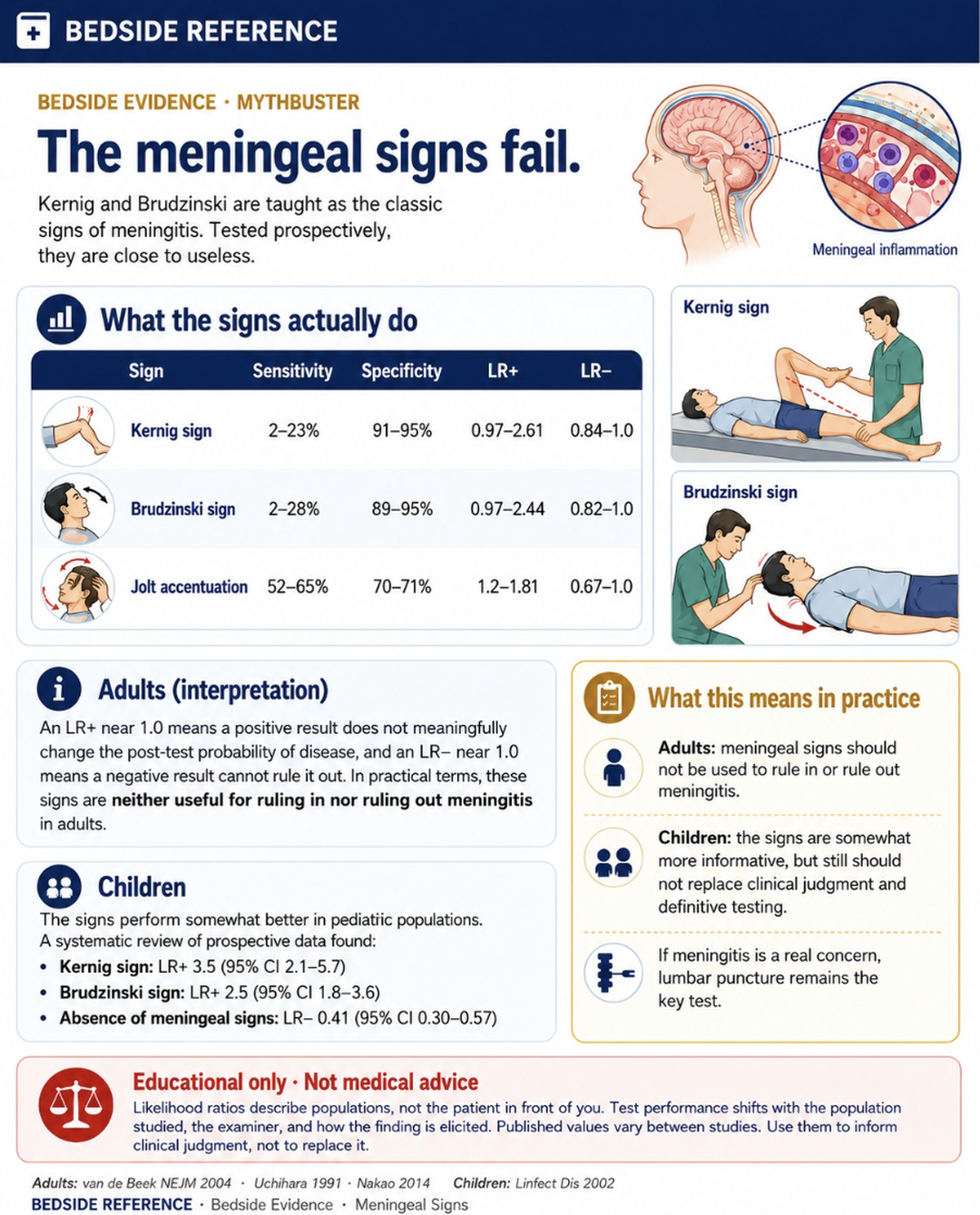
The meningeal signs fail.
Kernig, Brudzinski, and jolt accentuation have likelihood ratios near 1 in adults. The exam cannot rule out meningitis; do the LP.
Reviewed August 2026 · verify against current guidelines
The meningeal signs fail.
Kernig and Brudzinski are taught as the classic signs of meningitis. Tested prospectively, they are close to useless.
What the signs actually do
| Sign | Sensitivity | Specificity | LR+ | LR− |
|---|---|---|---|---|
| Kernig sign | 2–23% | 91–95% | 0.97–2.61 | 0.84–1.0 |
| Brudzinski sign | 2–28% | 89–95% | 0.97–2.44 | 0.82–1.0 |
| Jolt accentuation | 52–65% | 70–71% | 1.2–1.81 | 0.67–1.0 |
Adults (interpretation)
An LR+ near 1.0 means a positive result does not meaningfully change the post-test probability of disease, and an LR− near 1.0 means a negative result cannot rule it out. In practical terms, these signs are neither useful for ruling in nor ruling out meningitis in adults.
Children
- The signs perform somewhat better in pediatric populations. A systematic review of prospective data found:
- Kernig sign: LR+ 3.5 (95% CI 2.1–5.7)
- Brudzinski sign: LR+ 2.5 (95% CI 1.8–3.6)
- Absence of meningeal signs: LR− 0.41 (95% CI 0.30–0.57)
What this means in practice
- Adults: meningeal signs should not be used to rule in or rule out meningitis.
- Children: the signs are somewhat more informative, but still should not replace clinical judgment and definitive testing.
Adults: van de Beek NEJM 2004 · Uchihara 1991 · Nakao 2014. Children: Clin Infect Dis 2002. Likelihood ratios describe populations, not the patient in front of you; published values vary between studies. Use them to inform clinical judgment, not to replace it.
Sources
Verify against current guidelines and local protocol before acting.
- van de Beek NEJM 2004 · Uchihara 1991 · Nakao 2014 · Clin Infect Dis 2002 (children)
Downloads
Every card for this topic — carousels and tables, print-ready for the wards or for sharing.