The damped arterial line.
A blood pressure is a waveform before it is a number. Flush the line, count the oscillations after the flush, and you know which number to believe.
Reviewed August 2026 · verify against current guidelines
The damped arterial line.
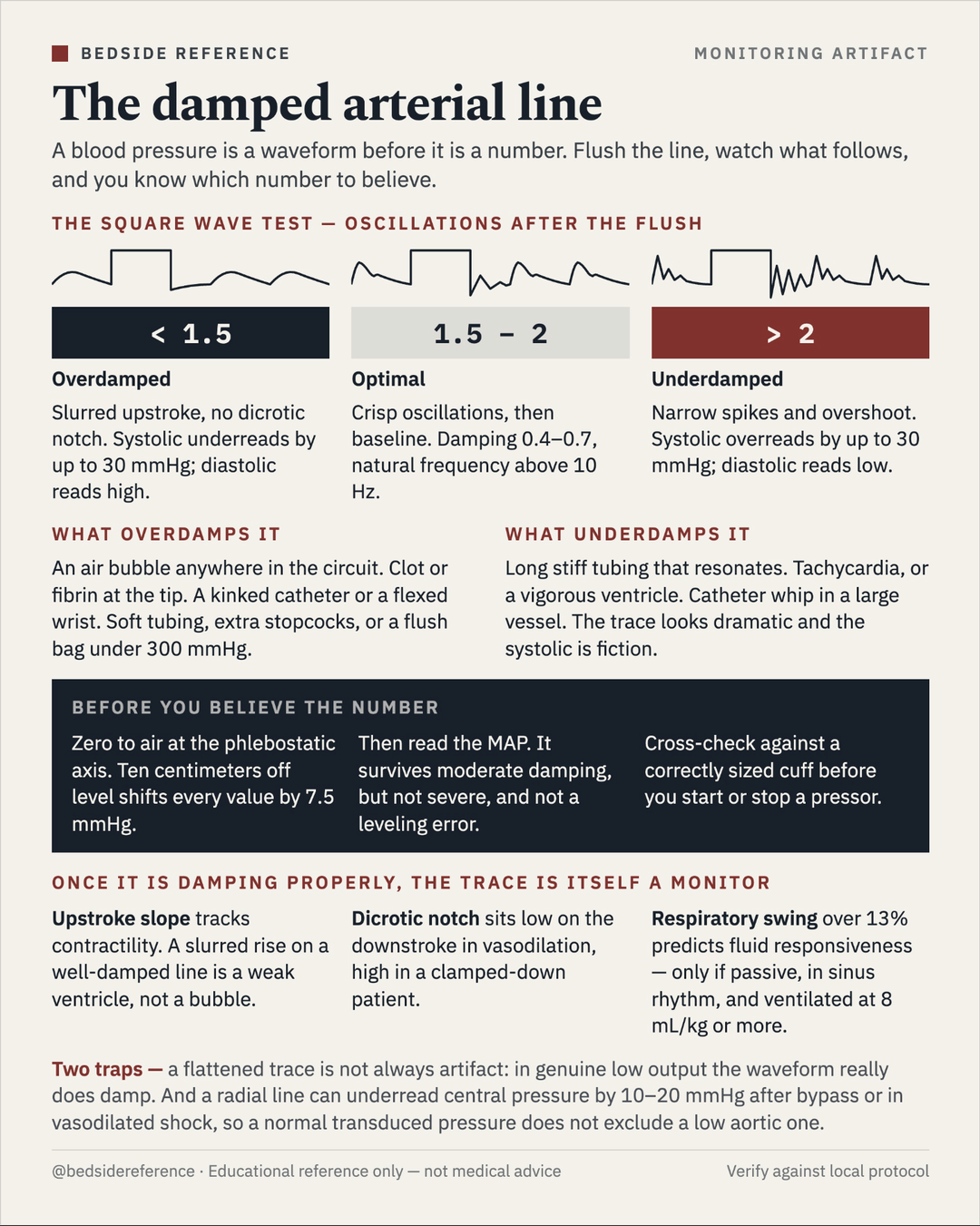
A blood pressure is a waveform before it is a number. Flush the line, watch what follows, and you know which number to believe. The square wave test takes two seconds: count the oscillations after the flush.
The square wave test — oscillations after the flush
| Count | Verdict | What it means |
|---|---|---|
| <1.5 | Overdamped | Slurred upstroke, no dicrotic notch. Systolic underreads by up to 30 mmHg; diastolic reads high. |
| 1.5–2 | Optimal | Crisp oscillations, then baseline. Damping 0.4–0.7, natural frequency above 10 Hz. |
| >2 | Underdamped | Narrow spikes and overshoot. Systolic overreads by up to 30 mmHg; diastolic reads low. |
What overdamps it
- An air bubble anywhere in the circuit.
- Clot or fibrin at the tip. A kinked catheter or a flexed wrist.
- Soft tubing, extra stopcocks, or a flush bag under 300 mmHg.
What underdamps it
- Long stiff tubing that resonates.
- Tachycardia, or a vigorous ventricle.
- Catheter whip in a large vessel. The trace looks dramatic and the systolic is fiction.
Before you believe the number
- Zero to air at the phlebostatic axis. Ten centimeters off level shifts every value by 7.5 mmHg.
- Then read the MAP. It survives moderate damping, but not severe, and not a leveling error.
- Cross-check against a correctly sized cuff before you start or stop a pressor.
Once it is damping properly, the trace is itself a monitor
- Upstroke slope tracks contractility. A slurred rise on a well-damped line is a weak ventricle, not a bubble.
- Dicrotic notch sits low on the downstroke in vasodilation, high in a clamped-down patient.
- Respiratory swing over 13% predicts fluid responsiveness — only if passive, in sinus rhythm, and ventilated at 8 mL/kg or more.
Dynamic response (fast-flush) testing per Gardner, Anesthesiology 1981. Educational reference only — verify against local protocol.
Sources
Verify against current guidelines and local protocol before acting.
- Gardner, Anesthesiology 1981 — dynamic response (fast-flush) testing
Downloads
Every card for this topic — carousels and tables, print-ready for the wards or for sharing.