Does this finding matter?
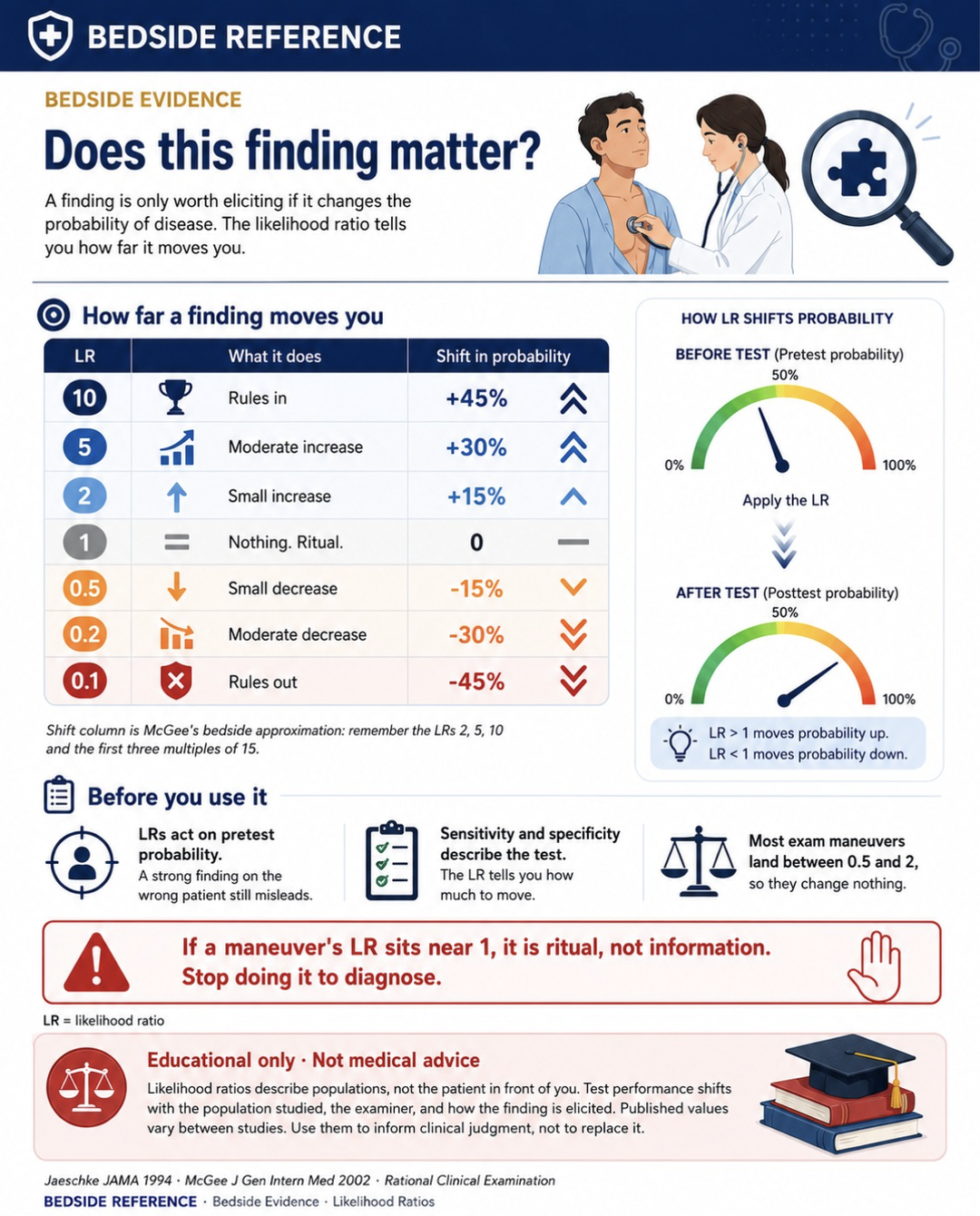
How to read a likelihood ratio at the bedside: LR >10 rules in, <0.1 rules out, and most exam maneuvers sit near 1 and change nothing.
Reviewed July 2026 · verify against current guidelines
Bedside Evidence
Does this finding matter?
A finding is only worth eliciting if it changes the probability of disease. The likelihood ratio tells you how far it moves you.
How far a finding moves you
| LR | What it does | Shift in probability |
|---|---|---|
| 10 | Rules in | +45% |
| 5 | Moderate increase | +30% |
| 2 | Small increase | +15% |
| 1 | Nothing. Ritual. | 0 |
| 0.5 | Small decrease | -15% |
| 0.2 | Moderate decrease | -30% |
| 0.1 | Rules out | -45% |
Shift column is McGee's bedside approximation: remember the LRs 2, 5, 10 and the first three multiples of 15.
Before you use it
- LRs act on pretest probability. A strong finding on the wrong patient still misleads.
- Sensitivity and specificity describe the test. The LR tells you how much to move.
- Most exam maneuvers land between 0.5 and 2, so they change nothing.
If a maneuver's LR sits near 1, it is ritual, not information. Stop doing it to diagnose.
LR likelihood ratio
Sources
Verify against current guidelines and local protocol before acting.
- Jaeschke JAMA 1994 · McGee J Gen Intern Med 2002 · Rational Clinical Examination
Downloads
Every card for this topic — carousels and tables, print-ready for the wards or for sharing.