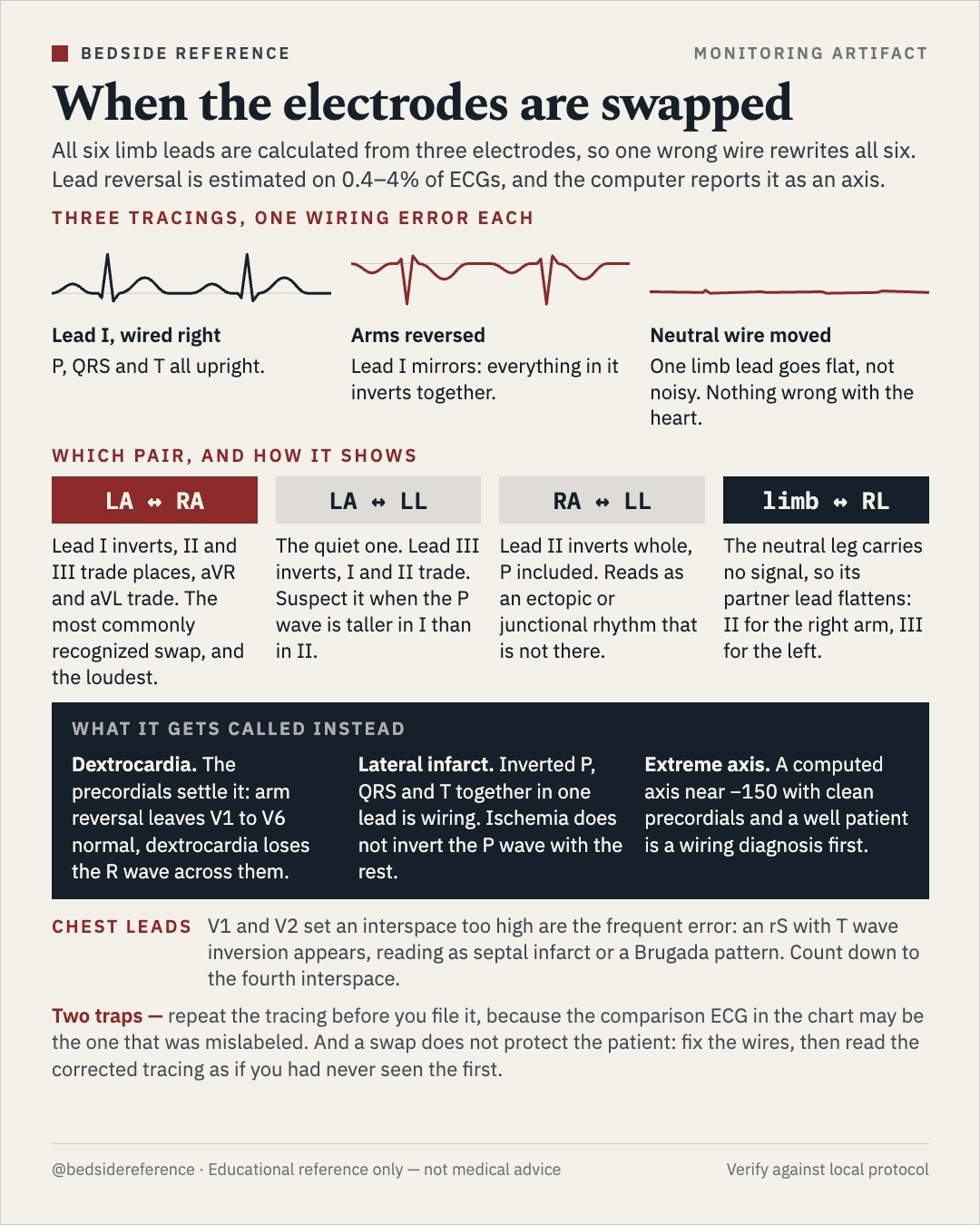
When the electrodes are swapped.
All six limb leads are calculated from three electrodes, so one wrong wire rewrites all six. Inverted P, QRS and T together in one lead is wiring, not infarct — check before you treat.
Reviewed September 2026 · verify against current guidelines
When the electrodes are swapped.
All six limb leads are calculated from three electrodes, so one wrong wire rewrites all six. Lead reversal is estimated on 0.4–4% of ECGs, and the computer reports it as an axis.
Three tracings, one wiring error each
| Lead I, wired right | P, QRS and T all upright. |
|---|---|
| Arms reversed | Lead I mirrors: everything in it inverts together. |
| Neutral wire moved | One limb lead goes flat, not noisy. Nothing wrong with the heart. |
Which pair, and how it shows
| Swap | What you see |
|---|---|
| LA ↔ RA | Lead I inverts, II and III trade places, aVR and aVL trade. The most commonly recognized swap, and the loudest. |
| LA ↔ LL | The quiet one. Lead III inverts, I and II trade. Suspect it when the P wave is taller in I than in II. |
| RA ↔ LL | Lead II inverts whole, P included. Reads as an ectopic or junctional rhythm that is not there. |
| limb ↔ RL | The neutral leg carries no signal, so its partner lead flattens: II for the right arm, III for the left. |
What it gets called instead
- Dextrocardia. The precordials settle it: arm reversal leaves V1 to V6 normal, dextrocardia loses the R wave across them.
- Lateral infarct. Inverted P, QRS and T together in one lead is wiring. Ischemia does not invert the P wave with the rest.
- Extreme axis. A computed axis near −150 with clean precordials and a well patient is a wiring diagnosis first.
Chest leads
V1 and V2 set an interspace too high are the frequent error: an rS with T wave inversion appears, reading as septal infarct or a Brugada pattern. Count down to the fourth interspace.
Educational reference only — verify against local protocol.
Sources
Verify against current guidelines and local protocol before acting.
- Batchvarov VN, Malik M, Camm AJ. Incorrect electrode cable connection during electrocardiographic recording. Europace 2007;9:1081–1090.
- Rudiger A, et al. Influence of electrode misplacement on the electrocardiographic signs of inferior myocardial ischemia. Am J Emerg Med 2007.
- Harrigan RA, Chan TC, Brady WJ. Electrocardiographic electrode misplacement, misconnection, and artifact. J Emerg Med 2012.
- García-Niebla J, et al. Technical mistakes during the acquisition of the electrocardiogram. Ann Noninvasive Electrocardiol 2009 (V1–V2 placement).
Downloads
Every card for this topic — carousels and tables, print-ready for the wards or for sharing.