Acute COPD exacerbation.
AECOPD definition and mimics, oxygen target 88–92%, bronchodilators and 5-day prednisone (REDUCE), GOLD 2026 severity and antibiotic criteria, NIV indications, and a discharge bundle.
Reviewed October 2026 · verify against current guidelines
Corrected October 2026 — this page follows the GOLD 2026 report. The slides for this series are being revised and will return here. For the full GOLD 2026 pathway, use the COPD management tool.
Diagnosis & Workup
Recognize. Confirm. Stage.
Definition (GOLD 2026)
Acute worsening of respiratory symptoms (↑ dyspnea, cough, sputum volume or purulence) requiring additional therapy.
Severity (Rome 2021, adopted by GOLD 2026)
| Mild | Default when the moderate threshold is not met. Dyspnea VAS <5 · RR <24 · HR <95 · SpO2 ≥92% and change ≤3% · CRP <10 |
|---|---|
| Moderate | At least 3 of 5: VAS ≥5 · RR ≥24 · HR ≥95 · SpO2 <92% and/or a fall >3% · CRP ≥10 |
| Severe | Clinical criteria as for moderate, plus, if a gas is obtained, hypoxemia (PaO2 ≤60 mmHg) and/or hypercapnia with acidosis (PaCO2 >45 mmHg and pH <7.35) |
Rule out mimics
| Differential | Pneumonia, acute HF or pulmonary edema, PE, pneumothorax, ACS, arrhythmia. |
|---|---|
| Workup | CXR, ECG, BNP, troponin. D-dimer if PE risk. |
Hypercapnic acidosis (PaCO2 ≥45 mmHg and pH ≤7.35) = start NIV (GOLD 2026, Figure 4.8). Do not wait for fatigue.
VAS visual analog scale (dyspnea)CRP C-reactive proteinNIV non-invasive ventilationACS acute coronary syndrome
Acute Management
First moves. First hours.
Treatment bundle
| Oxygen | Target SpO2 88-92%. Venturi mask to titrate. Recheck ABG 30-60 min. |
|---|---|
| Bronchodilators | SABA plus SAMA nebs (albuterol 2.5 mg, ipratropium 0.5 mg) q1–4 h, then q4–6 h. |
| Steroids | Prednisone 40 mg PO × 5 d (REDUCE; GOLD 2026). Oral is as effective as IV; use IV only if the patient cannot take oral. |
| Antibiotics | Per GOLD 2026 criteria below. Duration 5 days (5–7 days in hospital). |
Antibiotic indications (GOLD 2026, any of)
| ≥2 cardinal symptoms | ↑ dyspnea, fever, ↑ sputum volume, ↑ sputum purulence. Purulence must be one of them. |
|---|---|
| Prior positive culture | Positive sputum culture during a previous exacerbation. |
| On ventilation | Mechanical ventilation (invasive or NIV). |
Agent choice
| First-line | Aminopenicillin with clavulanate, a macrolide, or a tetracycline (e.g. doxycycline); a quinolone in selected patients. Follow local resistance patterns. |
|---|---|
| Pseudomonas risk | Antipseudomonal β-lactam (e.g. pip-tazo, cefepime). |
SABA short-acting β-agonistSAMA short-acting muscarinic antagonistABG arterial blood gasNIV non-invasive ventilation
Pitfalls & Disposition
What gets missed.
NIV (when and when not)
| Indications | Respiratory acidosis (PaCO2 ≥45 mmHg and pH ≤7.35) · severe dyspnea with signs of muscle fatigue or increased work of breathing · persistent hypoxemia despite oxygen |
|---|---|
| Contraindications | Respiratory arrest · hemodynamic instability · AMS · vomiting · copious secretions · facial trauma |
Intubation triggers
- NIV failure · arrest · refractory instability.
- Worsening AMS · persistent acidosis · cannot clear secretions.
Discharge bundle
- Inhaler technique verified. Watch them use it.
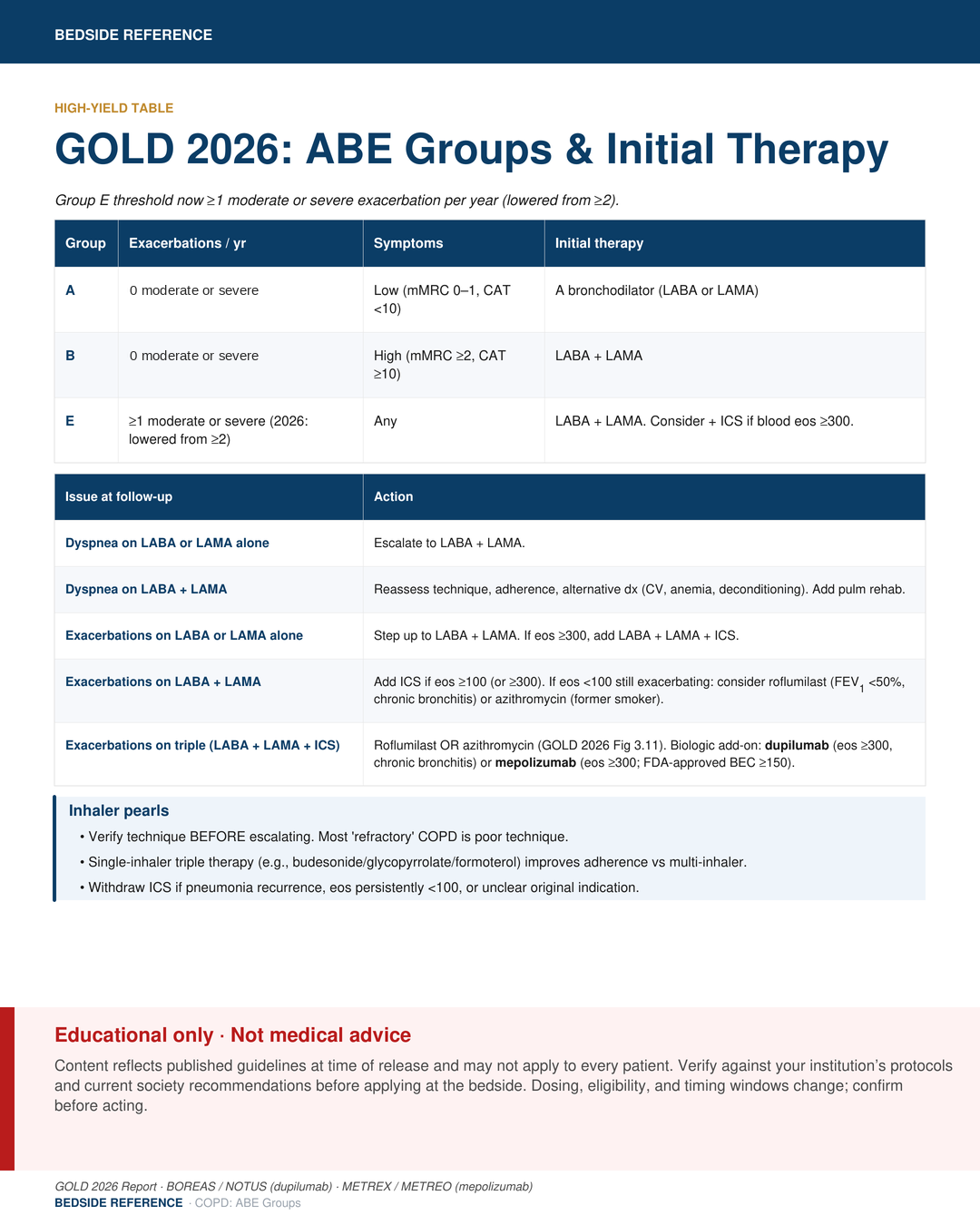
- Maintenance escalated if GOLD E (≥1 mod/severe per 2026).
- Pulm rehab referral, vaccines, smoking cessation, follow-up <4 weeks.
30–50% are readmitted within 30 days (GOLD 2026). Check inhaler technique before discharge; it is one of the factors you can fix.
NIV non-invasive ventilationWOB work of breathingAMS altered mental statusGOLD E GOLD high-exacerbation group
Sources
Verify against current guidelines and local protocol before acting.
- Global Initiative for Chronic Obstructive Lung Disease. GOLD 2026 Report (v1.3, December 2025): Figures 4.2, 4.4, 4.6, 4.8; pp. 94–108.
- Celli BR, et al. An updated definition and severity classification of COPD exacerbations: the Rome proposal. Am J Respir Crit Care Med 2021;204:1251–8.
- REDUCE trial (5-day vs 14-day prednisone). JAMA 2013.
- Anthonisen et al. Antibiotic use by cardinal symptoms in AECOPD. Ann Intern Med 1987.
- Brochard et al. Noninvasive ventilation in acute COPD exacerbation. NEJM 1995.
- O'Driscoll BR, et al. BTS guideline for oxygen use in adults in healthcare and emergency settings. Thorax 2017;72(Suppl 1):ii1–ii90 (target 88–92% in known COPD).
Downloads
Every card behind this topic, as published — view full size or download.